

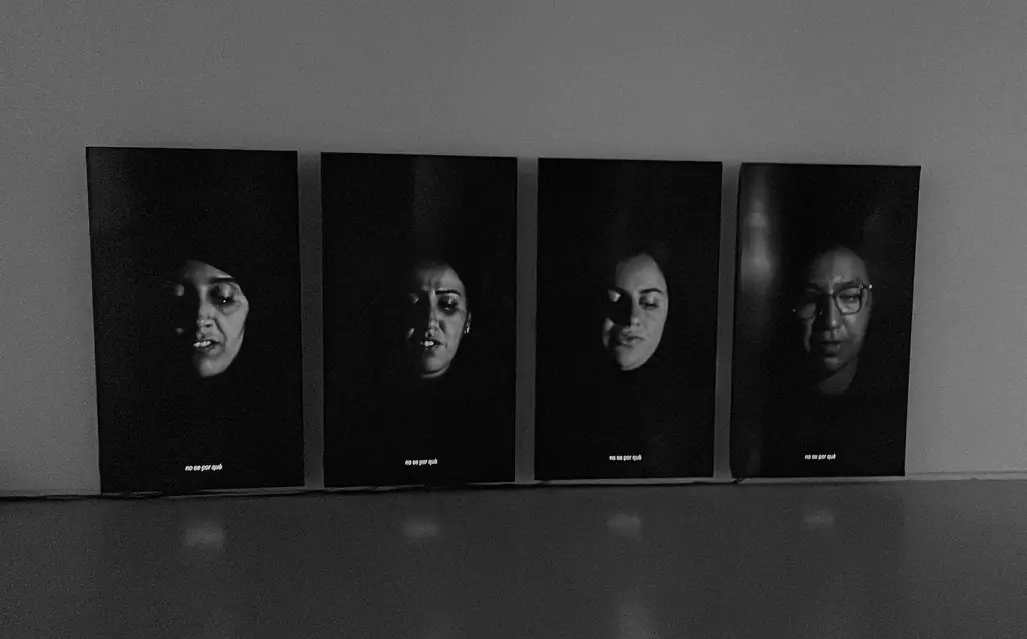
The women of the Asociación Tabadol created a play called “Los nombres del miedo,” which emerged following the power outage that has affected Cañada Real since 2020. For the museum, it was agreed to perform one of the segments of this play and transform it into an audiovisual piece. After a selection process, the segment “Con el miedo en el cuerpo” was chosen. Everything described in the play reflects real situations and experiences of these women. Those who volunteered to dramatize the reading and participate shared their own stories and those of their peers, turning the performance into a collective testimony.
The piece is a dramatized reading that highlights the voice as the protagonist to emphasize the intimate nature and bring to light the emotions captured in the text. Through a close-up of each face, we recreate the conditions in which the women live, recording in the dark with only a mobile phone for lighting. Performed by the women of the association themselves, the piece directly captures how the lack of electricity painfully impacts their lives. The forced darkness becomes an element of fear and vulnerability that violently and transversally marks their existence; it is a situation that structures their daily life, affecting even the most basic tasks.
For their children, the lack of light implies a constant difficulty in learning, as they depend on daylight hours for studying, lack access to basic digital resources, and the clear inequality of conditions affects their educational development compared to other children. The isolation is compounded when, due to the lack of internet connection, access to communication, information, administrative procedures, and job searches is cut off, placing them outside the basic circuits of social participation.
The absence of electricity also leads to serious health problems; besides the low winter temperatures, the dependence on gas for cooking, heating water, or heating becomes a permanent risk, and the constant use of candles increases the risk of fires. This imposed darkness becomes a manifestation of structural violence that precarizes their daily lives.