


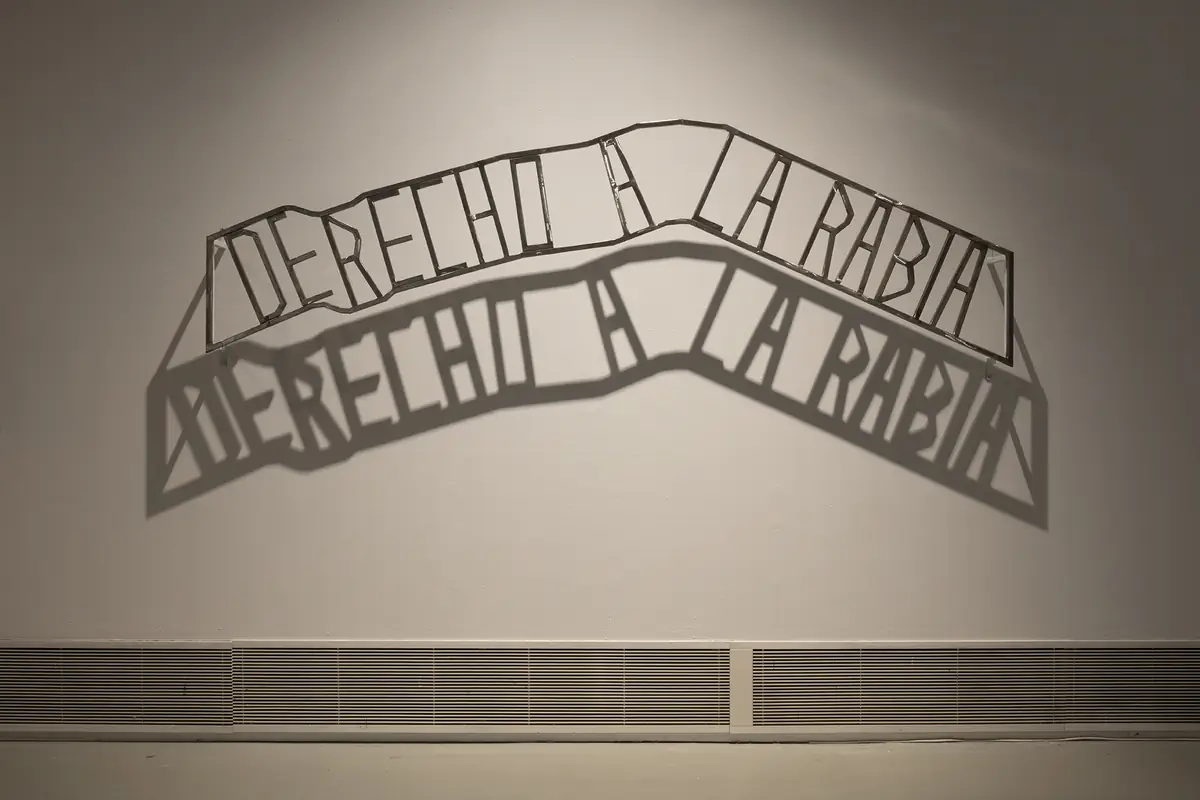
In this piece, the expression "Right to Rage" is presented in the form of a poster, inscribed within a frame that reproduces the outline of the path corresponding to the Cañada Real. The structure refers to the sign on the entrance gates of the Auschwitz concentration camp that read "Die arbeit macht frei" (work will set you free).
We take this reference as a critical exercise against what it means to ignore and dehumanize a neighborhood like Cañada Real, located just 15 minutes from Madrid, and which is not considered by the authorities as either a neighborhood or a community. We appropriate this strategy to critically address the stigmas that have been imposed against Cañada and the systematic racism to which its inhabitants are subjected.
Rage is pointed out as a right, the right not to be forced to forgive or forget while the structures that reproduce oppression persist. A right to feel and express that indignation, to use rage as a force of resistance and a practice of reparation. What this piece mainly captures is speaking of rage as memory and dignity.
"On the level of individuals, violence detoxifies. It frees the colonized from their inferiority complex, from their passive and despairing attitude. It intoxicates them because it restores their being. Violence illuminates because it shows the people the means and the ends."Frantz Fanon, The Wretched of the Earth (1961)".
Many authors have spoken of rage as an indispensable political resource in social struggles. Fanon, through his texts, has shown us how colonial violence inevitably generates a response of fury that can become a driver of emancipation. In decolonial feminism, it is emphasized that rage is not a problem to solve but a symptom of persistent coloniality and, at the same time, a fissure from which the struggle is articulated.
In hegemonic discourses, rage often appears as something negative, irrational, even dangerous. It is criminalized or pathologized, especially when it comes from colonized peoples, migrants, women, or racialized subjects. Coloniality not only plundered territories and bodies, but it also imposed an emotional regime in which it is expected that others respond with gratitude or silence. Thus, rage is proscribed, seen as an excessive or unjustified reaction.
The right to rage is a notion that has been articulated from anti-racist movements as a way to legitimize emotions historically disallowed in subalternized bodies and communities. Rage is not an obstacle or a pathology, but an embodied knowledge, a political resource, and a form of disobedience against coloniality. By claiming it as an affective memory of this unhealed colonial wound, we are not talking about an isolated individual feeling but a historical and collective expression that connects past violences with present ones. Rage is a trace and continuity of slavery, dispossession, and structural racism that operates to this day.